


The Dawn of a New Educational Era
Remember when creating an online course meant hours recording videos, designing slides, and writing assessments—while wondering if your content would resonate with students? Those days are becoming a relic. By 2025, artificial intelligence will have transformed how educators and content creators develop online learning experiences, making the process more efficient and effective. AI course creation tools are here!
Today’s AI-powered course creation tools can analyze learning patterns, generate customized content, create immersive visuals, and predict effective teaching approaches—all with minimal input from the creator. The result? Courses that are easier to build, more engaging, personalized, and successful for learners.
With so many options flooding the market, which AI tools belong in your course creation toolkit? Let’s explore the five essential AI-powered tools revolutionizing online education in 2025.
This article may contain affiliate links to tools I love and trust—if you choose to purchase through them, I may earn a small commission at no extra cost to you. Your support helps keep this blog running and full of free resources! 🔒✨
The AI Advantage: Why Traditional Course Creation No Longer Works
Before discussing specific tools, it’s important to understand why AI integration is essential for competitive course creators today. AI solves the limitations of traditional course development:
- Time constraints – Most educators spend 70-100 hours developing a single hour of quality content. AI reduces this by up to 70%.
- Personalization challenges – Without AI, creating differentiated learning paths for various student needs was prohibitively labor-intensive.
- Engagement barriers – Traditional courses struggle to maintain learner attention. Before AI optimization, completion rates for MOOCs averaged 13%.
- Feedback limitations – Manual assessment creation and grading bottlenecks slow the learning process.
- Improvement guesswork – Without data-driven insights, course improvements relied on limited feedback or instinct rather than comprehensive analytics.
One course creator said, “I was spending weeks creating content that might not connect with my students. Now AI handles the heavy lifting, and I can focus on adding the creative human touches that make learning memorable.”
Featured AI Course Creation Platforms: LearnWorlds and Kajabi
Two leading AI-powered platforms for online course creation are LearnWorlds and Kajabi. Let’s take a closer look at how these tools leverage artificial intelligence to enhance the course creation and delivery process:
LearnWorlds

LearnWorlds is an all-in-one online course platform that integrates a range of AI-driven features. Its intelligent course builder utilizes machine learning algorithms to:
- Automatically generate course outlines, lesson plans, and assessment questions based on your instructional content and learning objectives.
- Provide real-time recommendations for supplementary materials, practice activities, and remediation based on individual student performance and engagement.
- Analyze learner data to identify knowledge gaps, engagement patterns, and opportunities for personalization.
- Generate personalized learning paths and course recommendations for each student to optimize their learning experience.
LearnWorlds also features AI-powered video creation tools, including the ability to generate natural-looking voiceovers and animated explainer videos without any video production experience.
Kajabi

Kajabi is another comprehensive online course platform that leverages AI to streamline course creation and delivery. Some of its key AI-driven capabilities include:
- AI-assisted course and lesson planning, with the ability to automatically generate outlines, scripts, and assessment materials.
- Intelligent segmentation and personalization, using machine learning to deliver tailored course content, emails, and marketing offers to each student.
- Advanced analytics and reporting, providing deep insights into learner behavior, knowledge retention, and course performance.
- AI-powered virtual assistants that can answer student questions, provide feedback, and offer 24/7 support.
By integrating these AI-powered features, LearnWorlds, Kajabi, and other leading course platforms are empowering instructors and course creators to build more engaging, personalized, and data-driven online learning experiences.
The Transformative Five: Essential AI Tools for Modern Course Creators
1. Intelligent Content Architects: Streamlining Your Course Blueprint
Traditionally, the most time-consuming aspect of course creation has been content development. In 2025, intelligent architectures like Claude and OpenAI transformed how educators approach content development.
These platforms can now:
- Generate comprehensive course outlines based on learning objectives.
- Create first-draft content for modules that maintain consistent voice and style.
- Recommend optimal content sequencing based on cognitive learning science.
- Automatically identify knowledge gaps in existing course materials.
- Suggest relevant examples, case studies, and exercises tailored to specific audiences.
Course creator Maria Sanchez implemented CourseGPT Pro for her digital marketing certification program and reported, “What took me two months now takes two weeks, and the student feedback scores improved by 32%.”
Implementation Tip: While these tools excel at creating foundational content, successful courses still benefit from human refinement and the addition of personal expertise and experiences that AI cannot replicate.
2. Dynamic Video: Bringing Your Content to Life
Interactive, adaptive video experiences are replacing static lecture videos. Tools like Synthesia and InVideo are leading this transformation.


These next-gen video creation platforms offer:
- AI-generated presenters by age, ethnicity, gender, and speaking style.
- Real-time translation into multiple languages with proper lip-syncing
- Dynamic content that adapts based on viewer interactions
- Automated b-roll and visual aid generation that aligns with narration
- Engagement analytics identifying optimal video length and pacing
Have you considered how much more engaging your courses could be with visuals that adapt to each learner’s needs?
The University of Melbourne reported a 47% increase in student completion rates after implementing adaptive video technology in its online programs. This is a compelling case for its effectiveness.
3. Assessment Wizards: Beyond Multiple Choice

Assessment has evolved beyond simple quizzes. In 2025, AI-powered tools like Gradescope and Examity will provide:
- Auto-generated question banks targeting various cognitive levels
- Natural language processing to evaluate written responses and projects.
- Customized feedback that addresses specific learner misconceptions.
- Adaptive testing adjusts difficulty based on learner performance.
- Plagiarism detection with contextual understanding of original work.
These tools don’t just save time; they also improve the assessment experience for educators and learners.
4. Personalization Engines: The End of One-Size-Fits-All Learning
The most revolutionary aspect of AI in education is its ability to personalize learning at scale. In 2025, Knewton and Clever will represent the cutting edge of this technology.
These sophisticated platforms:
- Create dynamic learning paths based on individual progress and performance.
- When knowledge gaps are detected, recommend additional resources.
- Adjust content presentation based on learning styles.
- Schedule optimal review intervals using spaced repetition algorithms.
- Provide learners with metacognitive insights about their learning patterns.
Dr. James Wilson, Director of Digital Learning at Stanford Online, notes, “It’s like having a private tutor watching over each student. But instead of needing hundreds of teaching assistants, we’re achieving this level of personalization through intelligent algorithms.”
5. Analytics & Optimization Suites: Continuous Course Improvement
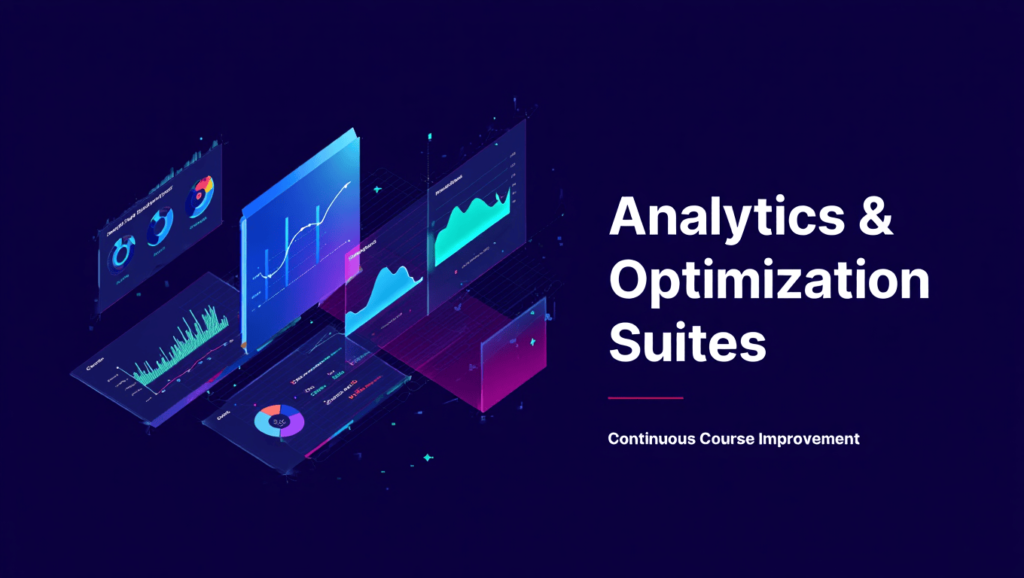
The final piece of the AI course creation ecosystem is robust analytics. Degreed and Docebo give course creators unprecedented insights:
- Heat maps showing engagement levels across content sections
- Predictive analytics identifying students of dropping out
- A/B testing functionality for different content approaches
- Sentiment analysis of student discussions and feedback
- Automated improvement recommendations from multi-cohort data
These analytics platforms transform course development from a one-time project into an evolving, continuous improvement process.
Implementation Guide: Integrating AI Into Your Course Creation Workflow

Implementing these AI tools requires a strategic approach:
- Start with clear learning objectives. AI works best with clear parameters about what you want students to learn.
- Build a content foundation. Use content architecture tools to develop your core materials before moving to enhancement tools.
- Layer in engagement elements after your foundational content is solid. Add dynamic video and interactive elements.
- Develop varied assessments. Create a mixture of automated and human-evaluated assessments.
- Enable personalization features. Once your core course is established, activate adaptive learning paths.
- Establish analytics benchmarks by determining your key performance indicators before launching.
- Plan for iterative improvement – Schedule regular reviews of analytics data to refine course elements.
FAQ: Common Questions About AI-Powered Course Creation
Q: Will AI-created courses lack the human touch that makes learning engaging? A: Not when implemented thoughtfully. The best AI-powered courses use technology for routine tasks, freeing educators to add personal coaching, storytelling, and relationship-building elements that require human expertise.
Q: How much technical knowledge is needed to use these AI tools? A: Most 2025 tools feature intuitive interfaces for educators without technical backgrounds, offering templates, wizards, and pre-built workflows.
Q: What about data privacy concerns with AI-powered learning? A: Leading educational AI platforms offer privacy controls, data anonymization, and compliance with global education privacy standards. Review the privacy policies and look for SOC 2 compliance and GDPR/CCPA adherence.
Q: Are these AI tools affordable for individual course creators? A: The market has diversified. While enterprise solutions remain expensive, many tools now offer “creator tier” pricing with monthly subscriptions ranging from $50-200, making them accessible to independent educators.
The Future of AI Course Creation
Looking ahead, emerging trends promise to transform course creation further:
- AI that detects and responds to learner frustration or confusion, and has emotional intelligence
- Virtual reality integration lets AI create immersive learning environments.
- Collaborative AI for group learning with intelligent facilitation
- Hyper-personalization using biological markers like attention levels.
The key to success will be balancing technological advancement with sound pedagogical principles. These tools are instruments for knowledgeable educators, not replacements for human expertise.
Investment: Cost Considerations and ROI
Implementing AI course creation tools requires initial investment, but the ROI can be substantial:
| Investment Area | Typical Cost Range | Potential Return |
|---|---|---|
| Content Generation | $50-300/month | 60-80% time savings |
| Video Production | $100-500/month | 40-60% cost reduction vs. traditional production |
| Assessment Systems | $75-250/month | 70% reduction in grading time |
| Personalization Tools | $150-600/month | 25-40% improvement in completion rates |
| Analytics Suites | $100-400/month | 15-30% improvement in learning outcomes |
For most course creators, the time savings and improved learning outcomes create a compelling business case for adoption.
The Human Element: Where You Matter Most
With all this technology, it’s worth remembering that the most memorable learning experiences still contain elements that AI cannot replicate: your unique expertise, passion, real-world experiences, and genuine connection with your students.
In 2025, the most successful course creators are those who strategically deploy AI to handle routine aspects of course creation while investing their human capital where it makes the biggest difference, not those who fully automate the educational experience.
What aspects of your course creation process could benefit most from AI assistance, allowing you to focus on sharing your unique expertise?
The answer might be the key to your next educational breakthrough.